
This section lists some of my projects to study various and varied electronic diagrams in real-life conditions, as well as their programming as appropriate.
Most often, these cards are used and then discarded in favour of final designs for their final application. I therefore put forward the well-established and functional developments, so that everyone can take advantage of them if necessary, study them, and thus increase the interest of these productions.
This section will be enriched as I research,
Think about checking again from time to time!
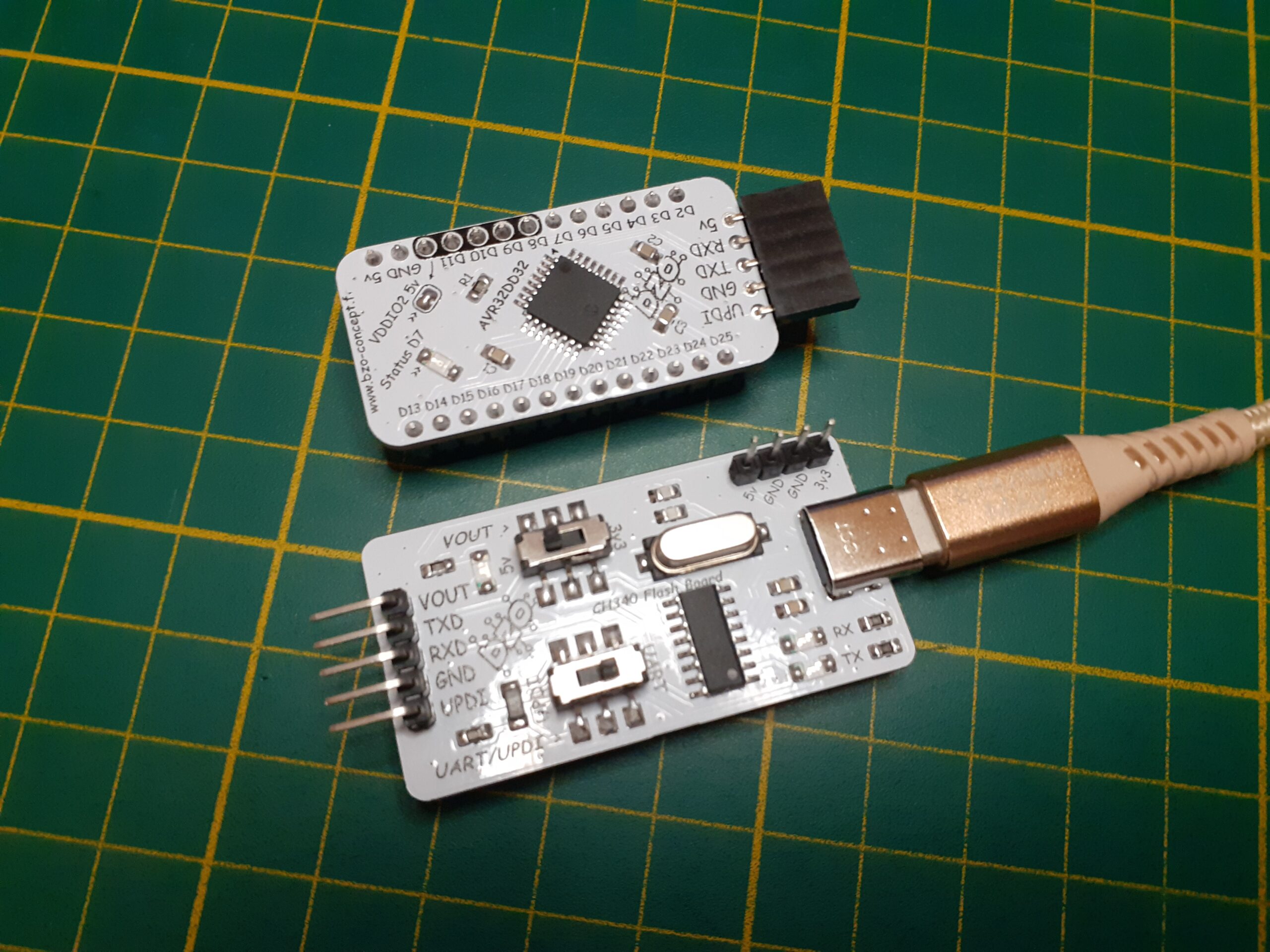
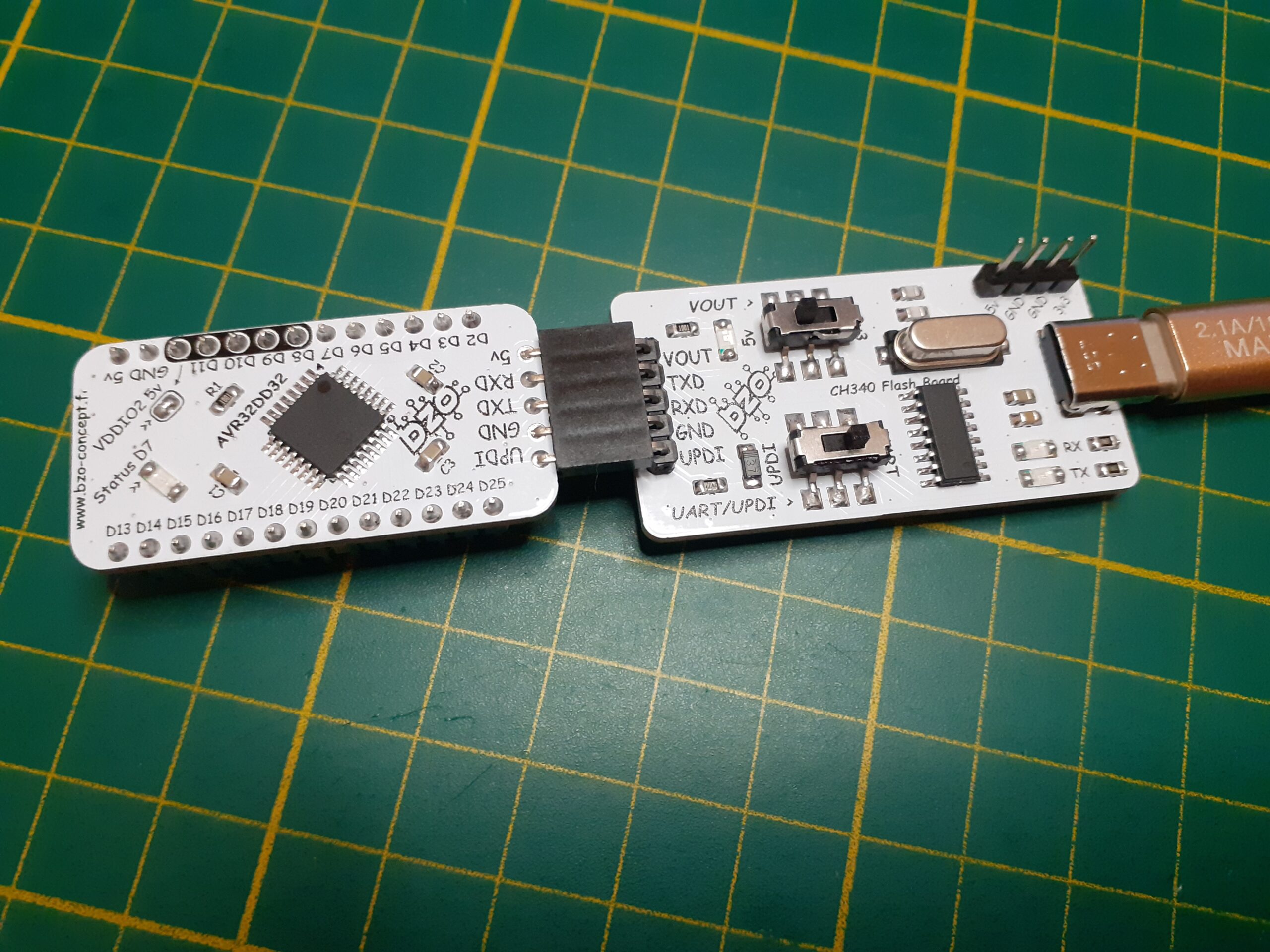
UART/UPDI Dongle and DevBoard AVR32DD32
The UART/UPDI dongle is designed for all kinds of programming and debugging. Based on CH340, it allows UART/USB connection, UPDI flash and fast access to 5v, 3V3 and GND rails in a fast and efficient way.
The DevBoard AVR32DD32 card is barely wider than an Arduino NANO and is used in the same way. However, a last-generation processor is installed, the case is the same as the classic 328P ATMEL, but the performance and possibilities are greatly enhanced: internal oscillator 24MHz, 23 ADCs, DAC, MVIO, multiple coms...
ArduinoIDE + DxCore programming by SpenceKonde.
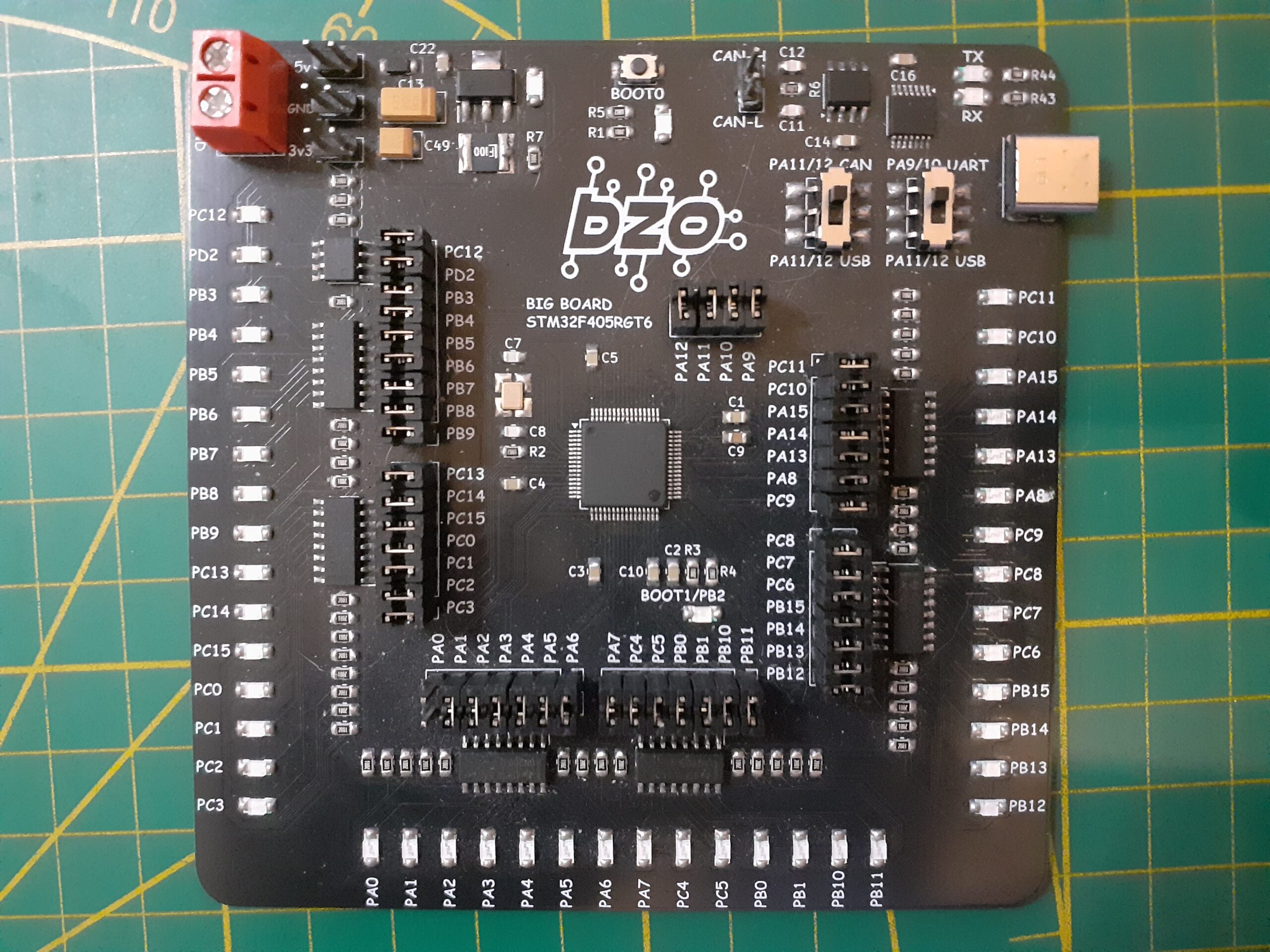
BigBoard STM32F405RGT6
This BigBoard (understand DevBoard large format) is very useful for testing the behavior of all spindles of the STM32F405RGT6 (small brother of the STM32F407VET6/VGT6) simultaneously. With darlington transistors to LEDs, and headers on all the useful pinout, it's my fatal weapon to detect steering, programming and pin assignment concerns on my ECUs. It is very useful also on the management of coms series and CAN, and for all quick firmware development tests.
ArduinoIDE + CoreSTM32 programming, or other
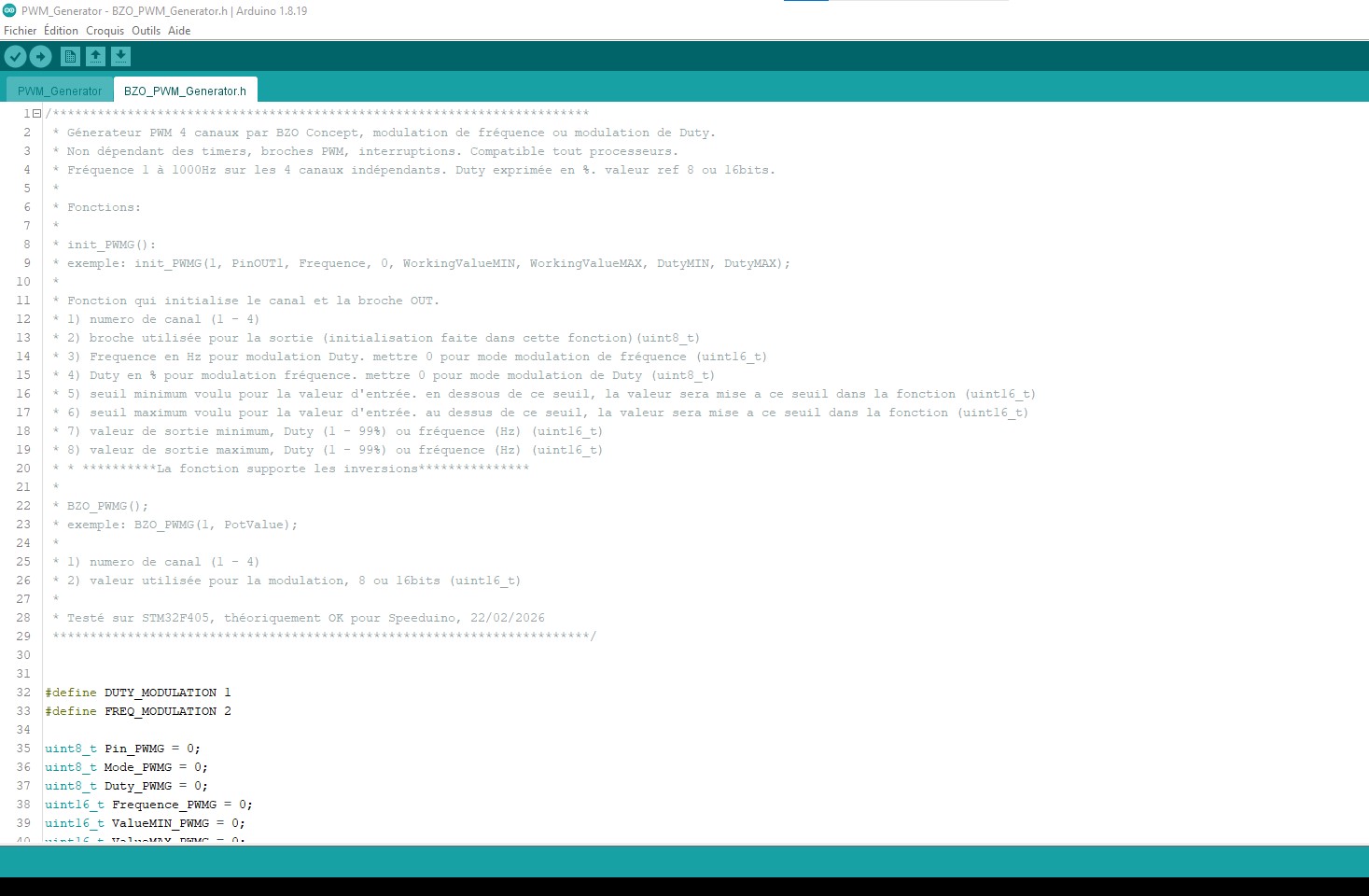
Arduino Bookshop BZO PWM Generator
This ArduinoIDE library allows you to generate PWMs on any processor and any spindle. This is because system time counting is used to control pins digitally, independently of timers other than that assigned to the operating time counter. It does not depend on any other library, and is written in such a way as to be understandable/modifiable.
simply declare the function to each loop to run it independently according to the desired value. works in duty modulation or frequency modulation, from 1 to 1000Hz, on 4 independent channels (possibility of larger frequencies and number of channels on quite fast processors)
Can be used on ATTiny, ATMega, STM32, see many others.
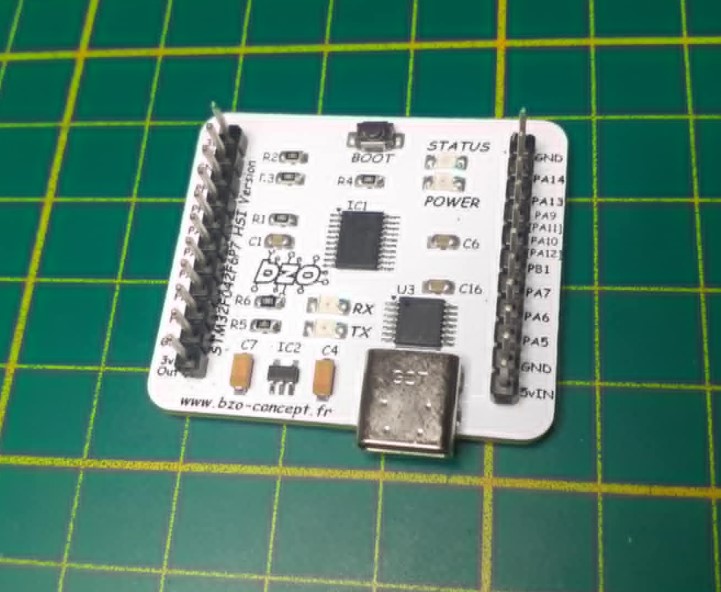
DevBoard STM32F042F6P7 TSSOP-20
This card allows to use one of the smallest processors in the STM32F range*******, STM32F042F6P6/7. its TSSOP-20 case and its 48MHz speed make it almost unbeatable on small simple projects. it is equipped with an MCP2221 for USB/UART conversion to make it compileable directly on ArduinoIDE. However the HAL USB direct works very well.
Another version with external clock and CAN transceiver exists, unfortunately I am not found how to use the canbus on this processor with ArduinoIDE, it would seem that CoreSTM32 is not fully operational for this processor at this level. It is therefore this version in internal clock (by default in the core) which is retained as operational and interesting.
ArduinoIDE + CoreSTM32 programming, or other

